Market Research in Germany 2026: AI-Moderated Interviews & Surveys in Practice
How German companies use AI-moderated interviews for market research. Top 5 use cases, data protection requirements, and best practices for the German market.

Dr. Andreas Ejupi
AI Research
The German market research industry is at a turning point in 2026. Rising costs for traditional methods, the shortage of qualified interviewers, the lack of depth in classic online surveys, and the pressure to deliver insights faster are driving demand for new solutions.
AI-moderated interviews offer an alternative: qualitative depth with quantitative scalability – and GDPR-compliant.
But how are German companies actually using this technology? And what should market researchers consider? According to Eurostat, around 80% of German companies have achieved basic digital intensity – yet many are still lagging behind in market research.
What are AI-Moderated Interviews?
AI-moderated interviews are surveys conducted by an artificial intelligence – think of it like a chat conversation. The AI asks questions in natural language, responds to answers in real-time, and dynamically adapts follow-up questions – similar to a human interviewer, but scalable to hundreds of participants simultaneously.
The key advantage: The AI recognizes when an answer remains superficial and probes further. This creates qualitative data at quantitative scale. Studies show that AI-powered probing leads to 39% more information content than traditional surveys (Xiao et al., 2020).
Learn more: The End of Static Surveys: Why AI Probing is the Secret to Deeper Insights
Why German Companies are Making the Switch
According to the Federal Statistical Office, one in five companies (20%) in Germany uses AI technologies – an increase of 8 percentage points within one year. Three factors are driving the adoption of AI-moderated interviews in market research:
1. Cost & Efficiency
Traditional qualitative studies with 30-50 in-depth interviews quickly cost €15,000-30,000 and take 4-6 weeks. Quantitative online surveys are cheaper but often only deliver superficial answers without the crucial “why.” AI-moderated interviews significantly reduce manual effort – while maintaining or improving data quality.
2. Scale Without Quality Loss
German companies that previously had to choose between “10 in-depth interviews” or “500 superficial survey responses” can now combine both: a survey with 500 interviews with qualitative depth.
3. GDPR & Data Sovereignty
For German companies, data protection is not a nice-to-have. The state data protection authorities closely monitor the processing of personal data. AI interview tools with EU hosting and transparent data processing are therefore mandatory.
Related: Bot Protection in AI Surveys – How to ensure authentic responses and data integrity.
Top 5 Use Cases in Germany

Where are German companies already using AI-moderated interviews? Here are the key application areas:
| Sector | Applications | Example Questions |
|---|---|---|
| 1. Corporations & Industry | Strategic market research, trend screening, R&D feedback | “What unsolved problems do you have in this area?” · “What would a provider need to offer for you to switch?” |
| 2. Automotive & Mobility | Customer feedback, user experience, mobility concepts | “How do you experience your dealer’s service?” · “What features are you missing in your vehicle?” |
| 3. Retail & Consumer Goods | Product tests, customer satisfaction, concept tests | “What motivated your purchase?” · “How do you perceive the value for money?” |
| 4. Banking & Insurance | Customer journey research, advisory quality, product development | “How did you experience the consultation process?” · “What information were you missing?” |
| 5. Politics & Opinion Research | Election research, voter motivation, social trends, sentiment analysis | “What influenced your voting decision?” · “How do you perceive the current political situation?” |
Of course, there are other areas where German companies use AI-moderated interviews – such as Healthcare & Pharma (patient feedback, therapy satisfaction) or Energy & Utilities.
German corporations and the Mittelstand use AI interviews for strategic questions. Retail uses them for fast feedback loops on product launches. Banks and insurance companies appreciate the ability to discuss sensitive financial topics in an anonymous format. The automotive industry – a core sector of the German economy – benefits from deeper insights into customer needs. And in opinion research, AI interviews enable deeper insights into voter motivation and social sentiment.
Data Protection in Germany: What You Need to Know
The German state data protection authorities enforce GDPR consistently. The following requirements apply to AI-moderated interviews:
| Requirement | Implementation |
|---|---|
| Legal Basis | Consent or legitimate interest – clearly documented |
| Transparency | Participants must know that an AI is conducting the interview |
| Data Minimization | Only collect necessary data, anonymize where possible |
| EU Hosting | Data processing within the EU preferred |
Tip: When selecting a tool, look for providers with EU server locations and transparent data processing documentation.
Criteria for Tool Selection
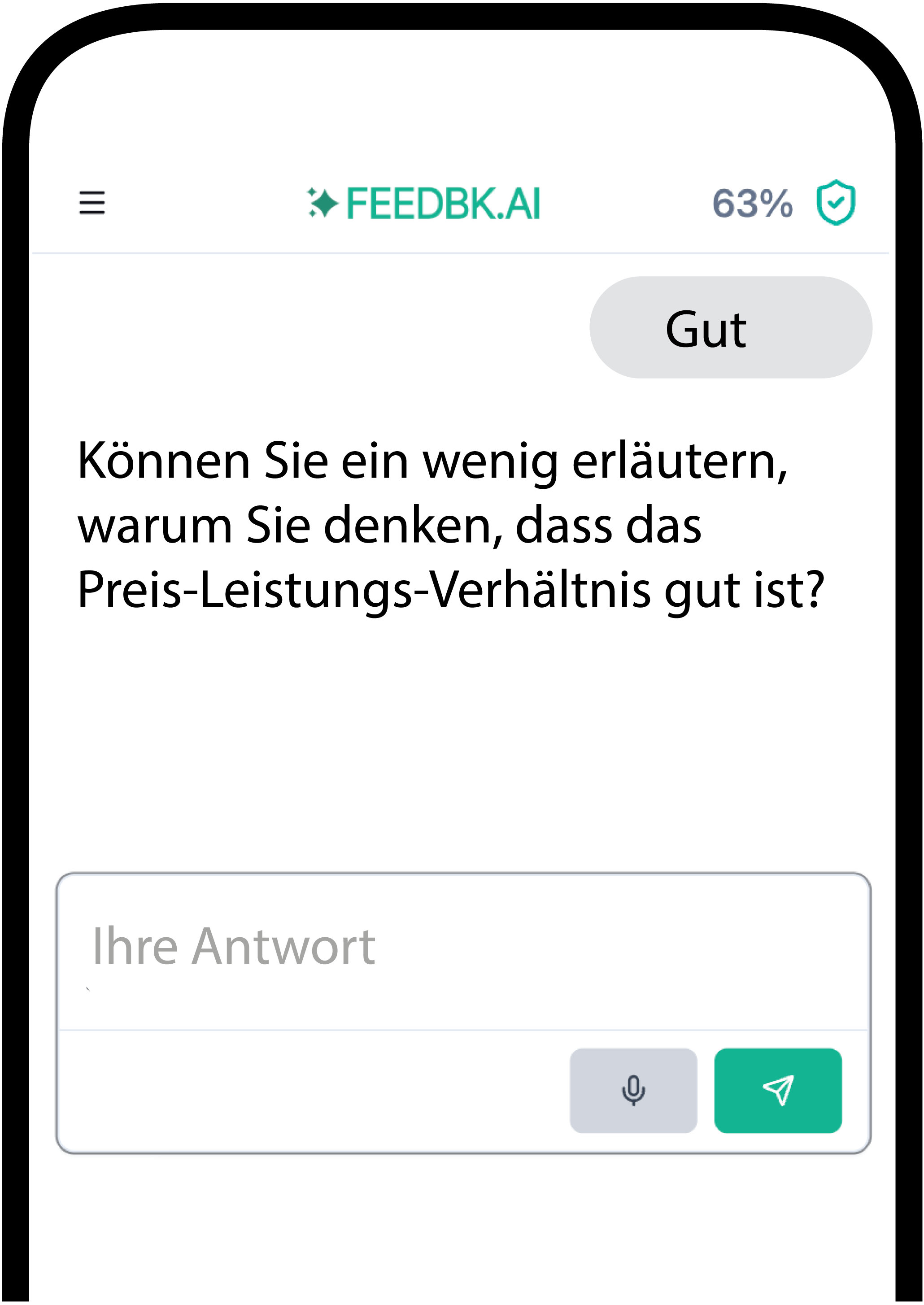
Not every AI interview tool is suitable for the German market. What you should look for:
Language & Localization
- Voice input capability for more natural, detailed responses
- High-quality German language output (not just translated)
- Understanding of DACH-specific expressions
Data Protection & Compliance
- EU hosting
- GDPR-compliant data processing
Methodology & Analysis
- Adaptive follow-up questions (probing)
- Combination of qualitative and quantitative questions
- Automatic transcription and theme analysis
Integration & Support
- Panel integration possible
- German-speaking support
- Quick setup without IT project
Conclusion: The Right Time for German Companies
AI-moderated interviews are no longer future technology in 2026 – they are an established tool for market research that combines qualitative depth with quantitative reach. For German companies, they offer a way to research faster and more cost-effectively without compromising on data quality.
Key takeaways:
- Scalability: Conduct hundreds of AI interviews in parallel
- Depth: Adaptive AI probing uncovers the “why”
- Compliance: GDPR-compliant in Germany with the right tool
- Versatility: From retail to automotive to corporate research
Further Reading
- Top 5 AI Interview Tools 2026 – Compare Outset, Listen Labs, Glaut, Conveo & Feedbk
- Market Research in Austria 2026 – Use cases for the Austrian market
- Employee Surveys with AI – Transform your HR feedback process
- Create a Survey with ChatGPT – Build AI-powered surveys in minutes
Try It Now
Want to test AI-moderated interviews in your organization?