The Death of the Static Survey: Why AI Probing is the Secret to 5x More Insights
Discover why AI-moderated interviews are replacing traditional surveys in 2026. Learn how adaptive probing and intelligent follow-ups unlock deeper qualitative data at scale.

Dr. Andreas Ejupi
AI Research
For decades, product managers and market researchers have been trapped in the “Research Paradox.” You could either choose scale (sending a survey to 1,000 people but getting shallow “yes/no” answers) or depth (spending weeks interviewing 10 people to understand their “why”).
In 2026, that trade-off is officially dead. At Feedbk.ai, we’ve analyzed how AI-moderated interviews are outperforming traditional methods. The secret isn’t just automation and open questions; it’s Intelligent Probing.
The “Dead End” of Traditional Surveys
Traditional surveys are static. If a user answers, “I found the checkout process frustrating,” a standard survey simply moves to the next question. You’re left wondering: What was frustrating? The loading speed? The UI? The payment options?
Without a follow-up, that data point is “thin.” You know a problem exists, but you don’t know how to fix it. This is why traditional surveys often miss the most critical information of the story—the nuance that only comes from a conversation.
What is AI Probing?
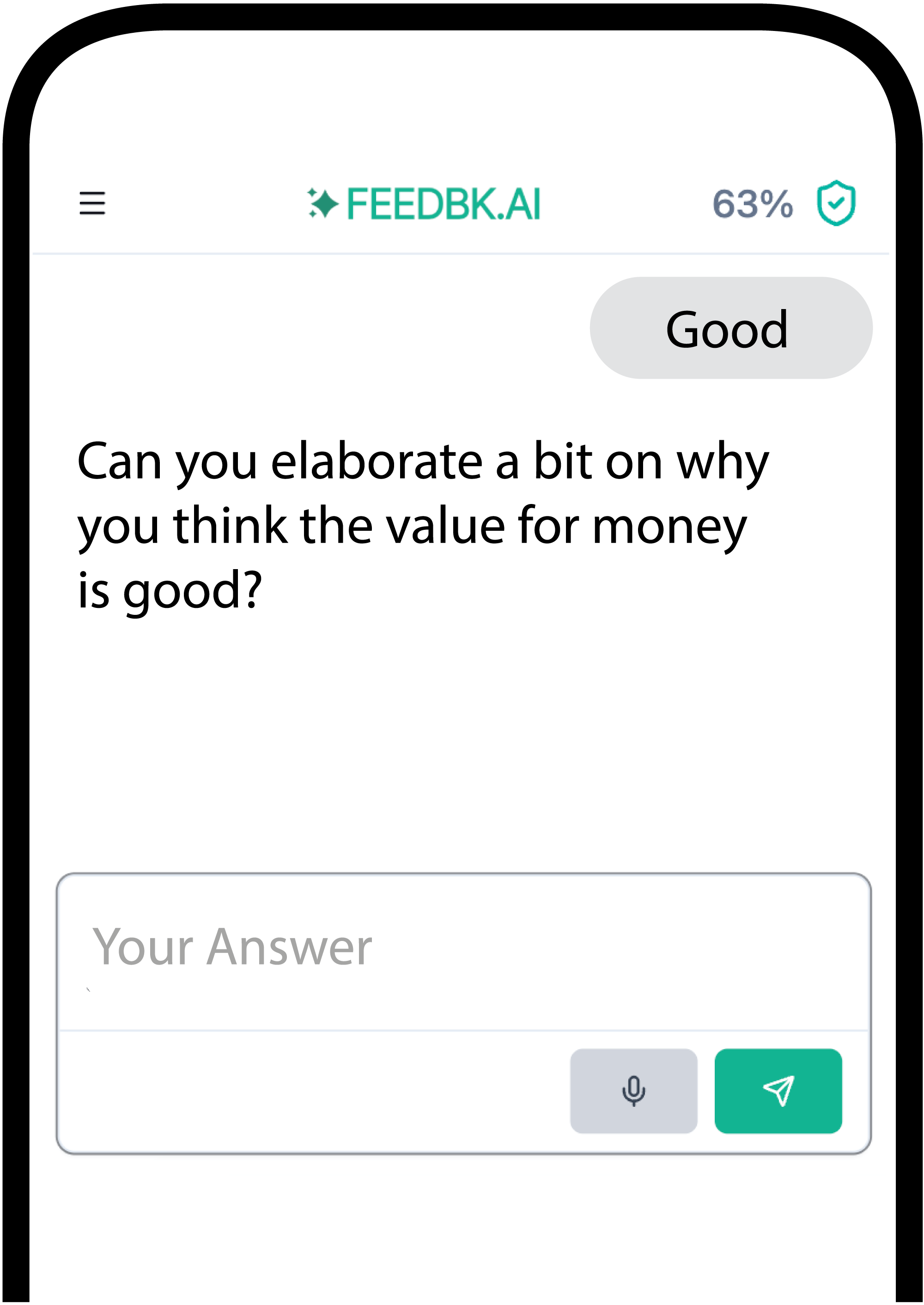
AI Probing (or dynamic follow-up) is the ability of an AI interviewer to listen to a response in real-time, identify an incomplete thought, and ask a relevant, contextual follow-up question.
Comparison: Traditional Surveys vs. AI-Moderated Interviews
| Metric | Traditional Survey | AI-Moderated Interview (Feedbk.ai) |
|---|---|---|
| Response Depth | 5–10 words avg. | 10–50+ words avg. |
| Actionable Insights | Requires manual “guessing” | Provided via automated follow-ups |
| Participant Engagement | High drop-off (Boredom) | High (Conversation feels personal) |
| Hidden Needs Discovery | 0% (Can only answer what’s asked) | High (AI follows the user’s lead) |
Why “Intelligent Follow-ups” Change the Game
1. Capturing the “Unspoken” Sentiment
Humans often use “hedging” language when they aren’t fully satisfied. An AI trained by Feedbk.ai can detect phrases like “It was okay” or “I think it worked.” or “Don’t like it” Instead of moving on, the AI probes: “You mentioned it was ‘okay’—was there a specific part that felt less than ideal?”
2. Scaling Qualitative Depth
Normally, conducting 50 qualitative interviews would take a researcher 100+ hours. With AI moderation, those 50 interviews happen simultaneously. You get the depth of a 1-on-1 session with the speed of a quantitative form.
3. Eliminating “Survey Fatigue”
Participants in 2026 hate long lists of radio buttons. They enjoy being heard. When an AI asks a smart follow-up based on what they just said, the participant feels their time is valued, leading to higher quality data and more words per response on average.
That said, quantitative questions still have their place - some questions require structured, comparable data. That’s why feedbk.ai uses a mixed approach: concise quantitative questions first, followed by intelligent open-ended follow-ups that adapt to each response.
Related: Conversational Surveys: Why Chat-Based Surveys Deliver Better Feedback – See how the chat format increases engagement.
Follow-up Strategies
AI probing isn’t random—it uses targeted strategies to dig deeper, uncover context, and reveal the “why” behind responses. The AI will automatically generate 2–3 follow-ups based on these strategies:
1. Clarification
- Goal: Define or explain an unclear term or phrase.
- When to apply: If the AI detects vague words like “nice” or “interesting”.
2. Elaboration
- Goal: Add more detail to a short or general answer.
- When to apply: When the response is brief or lacking specifics.
3. Example
- Goal: Provide a concrete example to illustrate the point.
- When to apply: If the participant speaks abstractly without examples.
…and more intelligent strategies that the AI uses behind the scenes to uncover richer insights and context automatically.
How to Implement AI Probing in Your Research
If you’re still using static forms, you’re leaving insights on the table. To start capturing the “why” behind your data:
Identify your “Important” questions: Look at your current survey. Which questions are most important to your decisions or insights? These are your best candidates for AI probing.
Define your follow-up: Decide how you want the AI to dig deeper. You can create a specific follow-up, guiding the direction (e.g., “ask more about their behavior”), or choose an automatic follow-up, where the AI selects the most effective probing strategy on its own.
Analyze the answers: Use Feedbk.ai’s automated analysis to see not just what people said, but the themes the AI uncovered through its probing.
Expert Insight: In 2026, the company that understands its customers fastest wins. Static surveys tell you what happened; AI-moderated interviews tell you why.
Further Reading
- Top 5 AI Interview Tools 2026 – Compare Outset, Listen Labs, Glaut, Conveo & Feedbk
- Conversational Surveys: Why Chat-Based Surveys Work Better – The complete guide to chat-based feedback
- Create a Survey with ChatGPT – Build AI-powered surveys in minutes
- Employee Surveys with AI – Transform your HR feedback process
Try It Now
Want to test AI-moderated interviews in your organization?